Written In English
7.25" H x 5" W x 1" D
*Wood’s Wonderful Nests takes you on a narrated tour of nest “architects” worldwide: the materials each species selects, the structural styles they employ, and the clever tricks they use to safeguard offspring. You’ll learn how climate and habitat, from African palms to European hedgerows, influence design, and why different birds adopt suspended, domed, burrowed, or platform nests according to their survival needs. Each illustration anchors the lesson, making it easy to envision a weaver-bird’s globular home or a swift’s clinging cup on a cliff face.*
Wonderful Nests, authored by the Rev. John George Wood and published by Longmans, Green, and Co. in London in 1892, is a charming extract from Wood’s larger work Homes Without Hands. Wood (1827–1889), a fellow of the Linnean Society and celebrated Victorian naturalist, set out to bring the marvels of animal architecture into parlors, classrooms, and boardrooms across Britain. With thirty meticulously engraved illustrations, this slim volume distills the very best of his chapters on nest-building, presenting the ingenuity of birds and other creatures in an accessible, engaging style.
At its heart, the book is a globe-spanning exploration of how different species construct shelters for their eggs and young. From the intricate grass baskets of African weaver-birds to the mud-daubed burrows of European swallows, Wood guides the reader through suspended pendants, domed retreats, and subterranean chambers. Each chapter explains the choice of materials; sticky saliva, feathers, twigs, or mud and highlights survival strategies such as waterproofing, predator-proof entrances, and camouflage. The result is both a scientific treatise and a celebration of nature’s craftsmanship, designed to feed the Victorian appetite for natural history while subtly imparting moral lessons about industry and ingenuity.
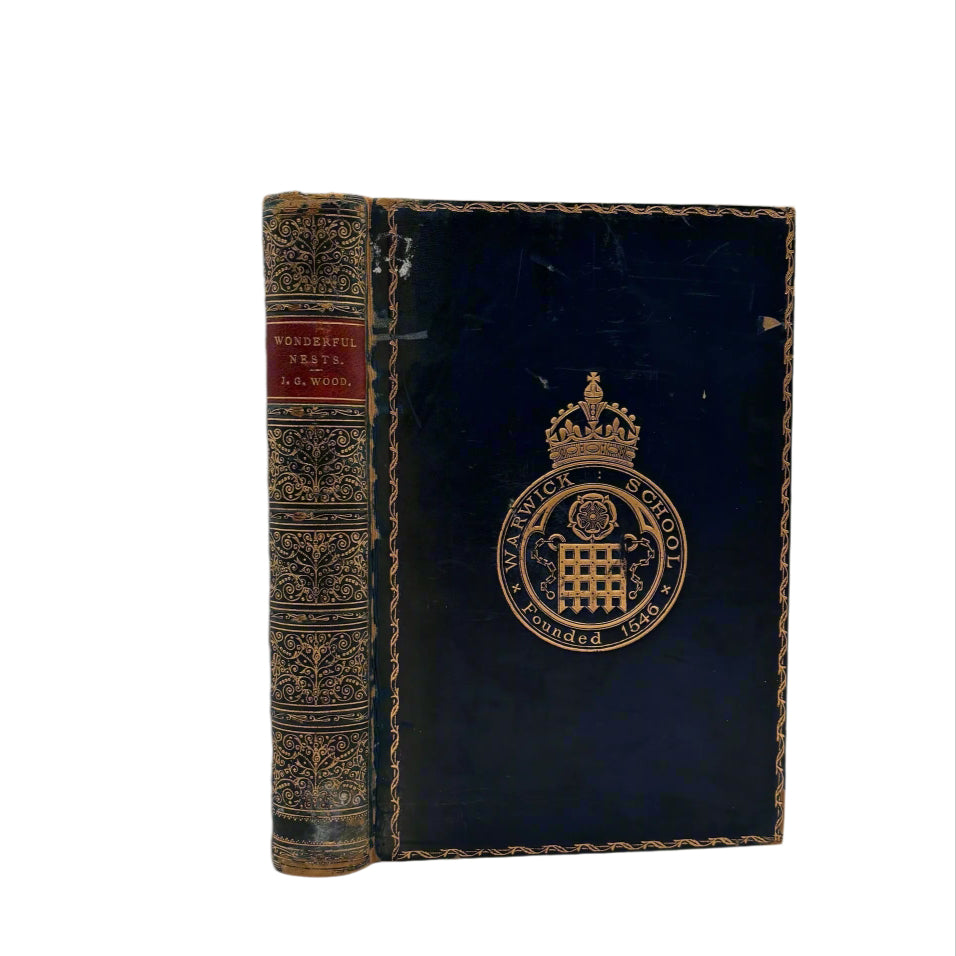
This particular copy was commissioned as an award for Warwick School; founded in 1546—and rebound in dark blue calf leather, complete with the school’s gilt-stamped emblem of a crowned Tudor rose and portcullis on both boards. The five-band spine, divided by a red morocco title label, is richly tooled with scrolling floral motifs. Inside, the original turn-ins reveal marbled endpapers in swirling red, blue, and mustard hues, and the diamond-shaped label of T. T. Cooke & Son, Booksellers & Stationers, Warwick, affirms its provenance. Such prize bindings were a Victorian tradition, elevating educational awards into treasured keepsakes.
Condition:
The binding is tight with sound hinges and no splitting; the leather shows only faint scuffing and minimal darkening at the spine head, and the gilt remains crisp. Marbled endpapers are bright with only trivial foxing, and the gilt edges retain full sheen. The textblock is square and the plates are clean, though the first few leaves bear light offsetting where the inscription appears. There are no tears, no losses, and only occasional, unobtrusive spots of age-tone to the margins.